Self-Taught on YouTube: How to Stop Guessing and Start Learning
Most people who start a channel start it alone. No team, no editor, nobody to tell them whether the thumbnail they just spent two hours on is any good. That part gets talked about as though it were the hard bit.
After nine years of building channels — since 2017, most of them faceless and aimed at English-speaking viewers — I do not think it is. Working alone is manageable. Working alone without a way of finding out whether you are right is what quietly ends channels.
The people who give up rarely run out of effort. They run out of belief, because month after month they have been busy without ever learning anything specific enough to act on.
The three-month pattern
It goes roughly like this.
Month one. You watch a stack of tutorials, plan an upload schedule, and believe that consistency is the whole answer. It is genuinely enjoyable.
Month two. Videos are still going out. Nothing much is moving. You start to wonder whether you picked the wrong subject, the wrong format, the wrong week.
Month three. The videos are out, the views are flat, the scripts feel thin, the thumbnails are not stopping anyone, and — this is the part that hurts — you have no idea which of those four things is the actual problem. So you change all of them at once, and the next video tells you nothing either.
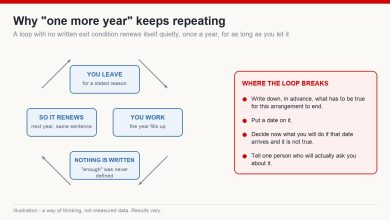
Somewhere in there people reach for the comfortable explanations: the platform is throttling me, the niche is dead, maybe I am just not built for this. Sometimes one of those is true. Far more often the real situation is duller. You are playing a game with rules, using instinct.
Practice is not the same as repetition
There is a difference between making fifty videos and making one video fifty times.
Repetition is publishing, waiting, feeling something vague about the result, and starting again from mood. Practice is publishing with a stated expectation, checking what actually happened, and carrying exactly one lesson into the next attempt.
The mechanism that separates them is embarrassingly low-tech: writing it down.
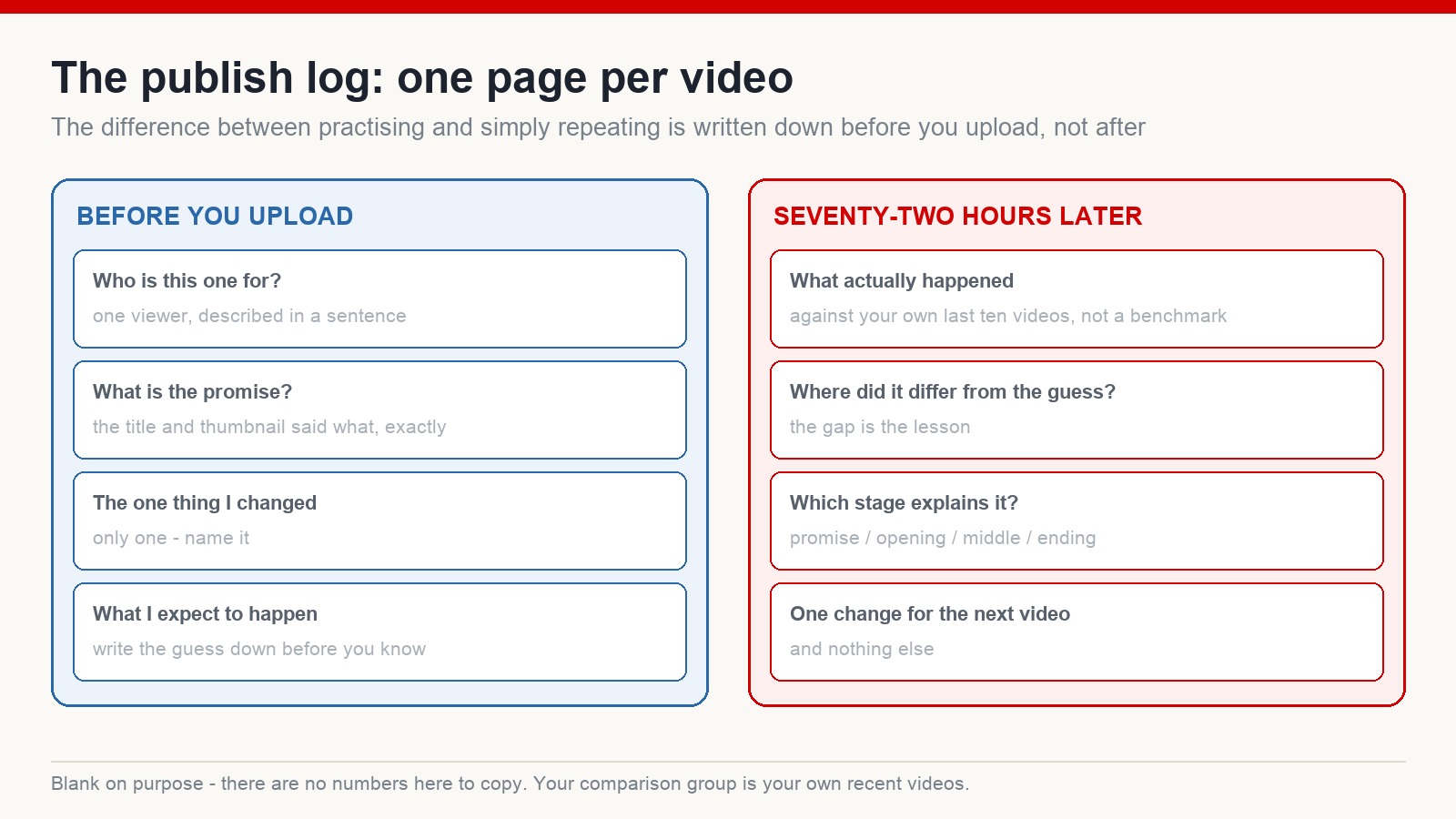
The publish log
One page per video. Half of it filled in before the upload, half of it three days later.
Before you upload, answer four things. Who is this specific video for — one viewer, described in a sentence, not "people interested in history". What exactly is the promise the title and thumbnail are making. What is the one thing you changed compared with the last video. And what do you expect to happen.
That last one matters more than it looks. Writing a prediction down before you know the answer is the only way to find out whether your instincts are improving. Everyone feels like an expert in hindsight.
Seventy-two hours later, answer four more. What actually happened. Where it differed from your guess. Which stage of the video best explains the difference. And the single change you will make next time.
Note what is missing from that list: any external benchmark. I deliberately do not chase published averages for click-through or watch time. They are collected from wildly different channel sizes, formats and countries, and they change. The only comparison group worth having is the median of your own last ten videos. It is small, it is yours, and it is honest.
Working out which stage broke
Nearly every underperforming video fails at one identifiable stage, and there is a sensible order to check them in.
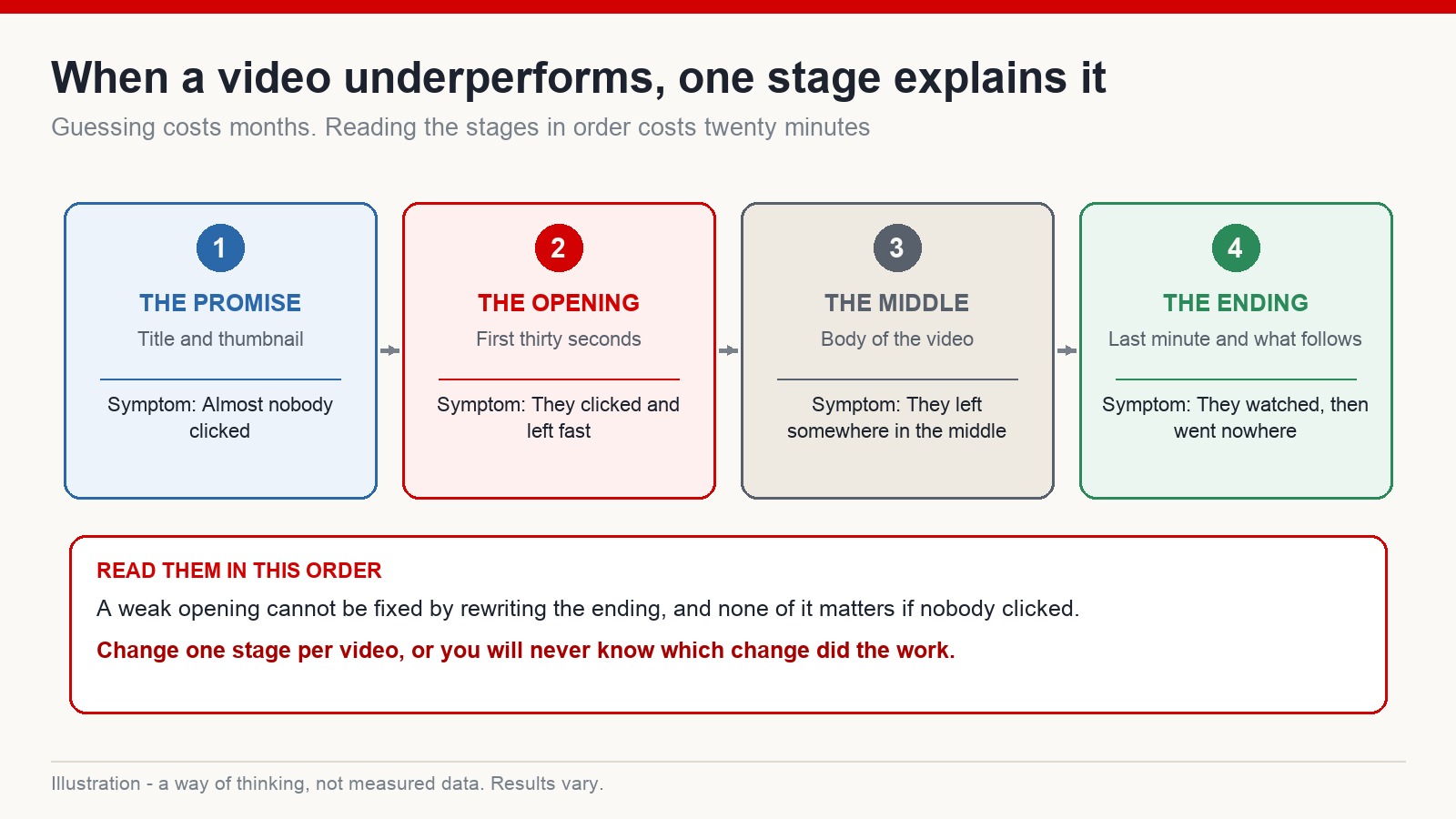
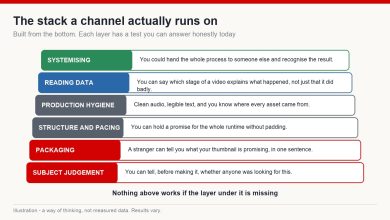
The promise. If almost nobody clicked, nothing further down the video is your problem yet. Show the title and thumbnail to someone with no context and ask what they think they would be getting. If they cannot answer in one sentence, that is the bug.
The opening. If people clicked and left within the first half-minute, the video did not start where the title pointed. Most weak openings are a greeting, a channel trailer and a slow warm-up before the thing the viewer came for.
The middle. If they leave partway through, find the moment on the retention graph and go and watch it. Usually it is a stretch where nothing new arrives — a point being restated, or a section that exists because you researched it, not because anyone needs it.
The ending. If they watched it and then went nowhere, the video finished without pointing anywhere. That is the cheapest of the four to fix and the one people most often leave broken.
The one-change rule
Change one thing per video.
It feels painfully slow, especially when you can see five things you would like to improve. But if you change the thumbnail style, the opening structure, the length and the topic in the same upload, the result is uninterpretable. You will have worked hard and learned nothing, which is exactly the state that makes people quit in month three.
Ten videos with one deliberate change each will teach you more than fifty videos of enthusiastic guessing.
Borrowing mistakes other people already paid for
A shortcut is not cheating. A shortcut is declining to pay tuition on a mistake somebody else has already paid for.
Working entirely alone means you personally fund every lesson: every misjudged topic, every thumbnail nobody clicked, every month spent polishing something the audience did not want. Some of that is unavoidable, because your channel is yours. Much of it is not.
Three ways to get outside eyes without a budget:
- Two or three peers at a similar stage. Not a large community — a small group who will actually look at your thumbnail before it goes live and tell you what they think it promises.
- Watch the winners in your subject with the sound off. Structure is visible without audio: where the hook lands, how quickly it cuts, when the payoff arrives. You are learning shape, not copying content.
- Read your own comments properly. The questions people ask are the parts you explained badly, and often the next three video ideas.
What a process cannot do
I would rather be honest about the limits than sell the method.
A good loop does not guarantee growth. It does not make a saturated subject less crowded, it does not survive a format going out of fashion, and it does not control platform policy or recommendation changes, which move without asking anyone. Results vary enormously between people, subjects and languages, and plenty of careful, disciplined creators grow slowly.
What a process does do is much more modest and much more useful: it converts a vague feeling of failure into a specific, fixable problem. That is the difference between a bad month and a reason to stop.
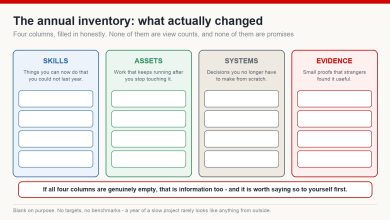
You do not have to be the best creator in your subject at the start. You have to still be improving in month nine, and that is a bookkeeping problem before it is a talent problem.
Is it a bad idea to teach yourself YouTube?
No. Almost everyone starts self-taught. The failure mode is not the absence of a teacher, it is the absence of a feedback loop — publishing without a stated expectation and reviewing without a record.
How long should I stick with one approach before changing it?
Long enough to have roughly ten videos to compare, changing one element at a time. Fewer than that and you are reading noise; a single video can do unusually well or badly for reasons that have nothing to do with your decisions.
Do I need paid tools to do this?
Not to start. The publish log works in a free spreadsheet, and the analytics built into your own channel cover the four stages above. Tools speed up research; they do not replace the loop.
If you want a structured version of this way of working for an English-speaking audience, that is what I put together at mmoyoutube.com.